PP Tile Basketball Flooring: Why Modular Courts Are Taking Over Outdoor Basketball

Outdoor basketball courts are the hardest-working surfaces in sports. They take sun, rain, dust, studs, skateboards and twenty years of jump stops. PP tile flooring became the default answer for a simple reason: it fails gracefully. Damage one tile, replace one tile.
What PP Tile Flooring Is
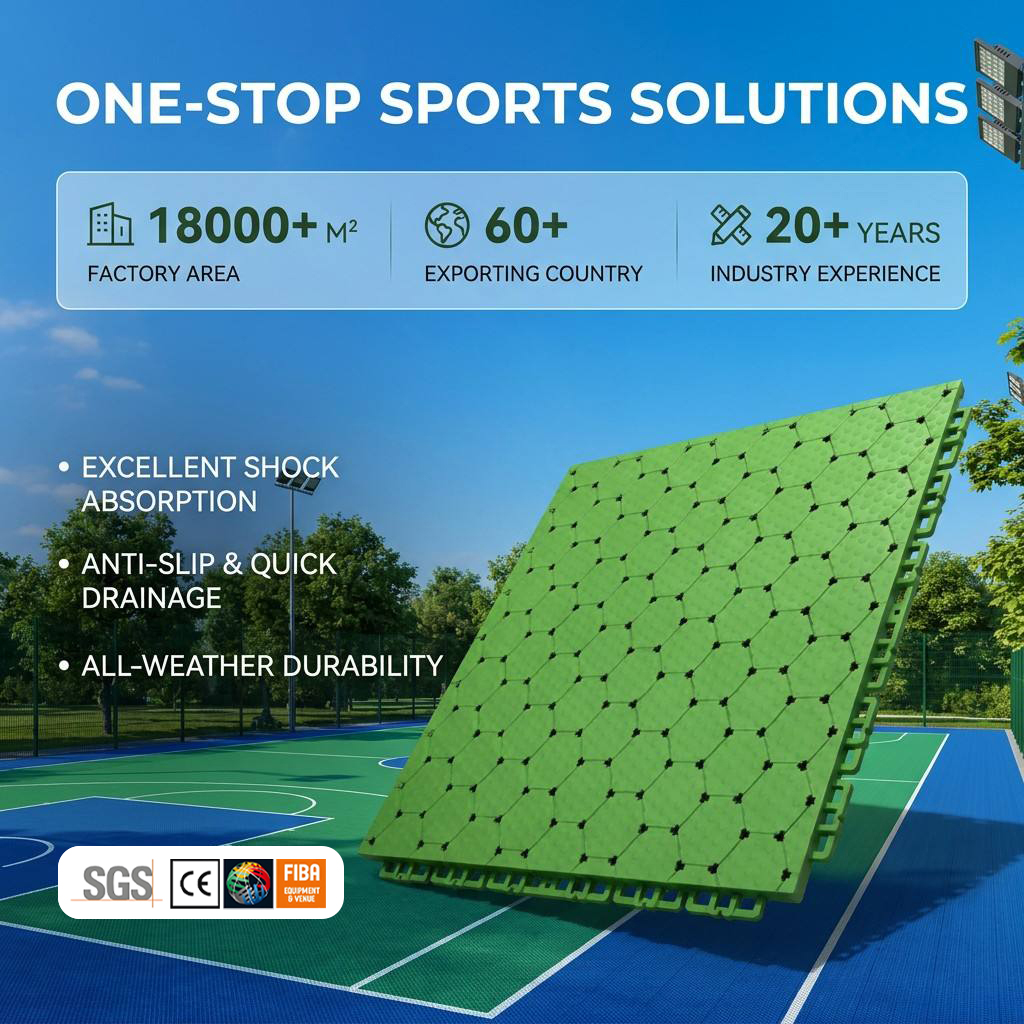
PP (polypropylene) sports tiles are injection-moulded modular panels, typically 30.5 × 30.5 cm, in 12.7 mm or 15.8 mm profiles. Each tile has a patterned wear surface on top and a lattice of support pillars underneath. Tiles click together with a hidden connector, and the whole court floats on the base — no adhesive, no screed, no curing time.
The gap pattern between tiles does two jobs: it lets rainwater drain straight through, and it gives the surface room to breathe as it expands in heat.
Why It Works for Basketball
Playable in an hour, not a week. A crew can lay a full court in one to two days. No primer, no mixing ratios, no weather window — which is why schools schedule PP courts over a weekend.
Drainage by design. Standing water is the main reason outdoor PU courts get closed. Open joints and a raised underside mean the court is usable minutes after rain.
Real ball response. A well-made 15.8 mm tile returns a predictable bounce and gives consistent grip wet or dry. Cheap, thin tiles feel hollow and dead — thickness and pillar density are what you are actually paying for.
Repairable and reconfigurable. Cracked tile, faded section, new line markings: swap individual pieces. You can also restripe a multi-use court without rebuilding the surface.
Base-friendly. It goes straight over sound asphalt or concrete, and can be lifted and relaid if the site is redeveloped.
Honest Limits
PP tile is not a competition indoor surface. It is firmer than a pour-in-place PU or rubber system, so shock absorption is lower — fine for school and community basketball, not what you would specify for a professional training facility. It is also not for spiked footwear; track spikes will damage the wear surface.
Two site conditions decide success. First, base flatness: tiles follow the ground, so hollows telegraph into dead spots and audible rattle. Second, edge restraint — without a proper ramp or anchor at the perimeter, the court creeps and gaps open at the ends. In very hot climates, specify UV-stabilised material and leave the expansion allowance the manufacturer states, not a smaller one because it looks neater.
TPV tiles use the same click-together concept with a softer, rubber-like compound — worth comparing if the court will host both basketball and general play.
| PP tile | TPV tile | Acrylic / PU court | |
|---|---|---|---|
| Surface feel | Firm, lively | Softer | Firm, seamless |
| Installation | 1–2 days, no adhesive | 1–2 days | 5–10 days, curing |
| Rain drainage | Through joints | Through joints | Depends on falls |
| Repair | Single tile | Single tile | Patch and recoat |
| Best fit | Schools, community, rooftop | Multi-use, comfort | Competition, indoor |
Installation in Short
- Base check — sound, clean, flat asphalt or concrete, with correct falls.
- Perimeter — edge ramps or anchors fixed first; this is what holds the court square.
- Laying — tiles clicked in a staggered pattern, working from a fixed datum so lines stay true.
- Cutting — perimeter tiles trimmed to the edge, expansion allowance kept.
- Marking and handover — moulded colour blocks or court paint, then a bounce and drainage check.
Specification Checklist
- Tile thickness and pillar structure — 12.7 mm or 15.8 mm, and how many support points per tile?
- Material grade — virgin PP copolymer or regrind? Ask for the UV stabiliser and weathering test data.
- Load and temperature data — expansion rate, and the manufacturer's stated allowance.
- Base tolerance — what flatness is required, and who is responsible if the asphalt is out?
- Warranty split — colour fading, breakage and connector failure are three different claims.
Talk to Us
Send us your court dimensions, base type and climate, and we will recommend a tile profile, colour layout and quantity — with a laying plan you can hand to the installer.
Joe Chen — Flyon Sports Email: Info@flyonsport.com WhatsApp: +86 13534071985
Happy National Day 2026 — Holiday Notice
Article associé